Official Description: Gianna talks with Dr. Robert Redfield about the decisiveness and the change of tone entering the Vatican under the spiritual leadership of Pope Leo XIV.
Note (By A Soul): There is a lot of discussion about healthcare and its emerging role within the Catholic Church.
About the Media Channel with host, Dr Gianna Talone-Sullivan: Victory Reigns is a Christian Podcast promoting Christian Grace. This podcast discusses current events, challenges, and positive gains in Christianity. We will discuss the issues Christians face today, report the facts, and discuss solutions. Victory Reigns shares the love of God for all.
An excellent interview with a hospice nurse that confirms a lot of the realities of the afterlife. Gives hope to believers in Christ. God bless.
Official Description:
Yvonne Jones has spent more than 30 years as an end of life nurse, and has personally witnessed hundreds of people take their final breath as human beings on this earth. What she shares about what she’s seen as people are dying might surprise you, and will likely give you a different perspective on something that, unless Jesus returns in your lifetime, you are guaranteed to experience.
YouTube Video – A Stronger Faith Ministries – What Happens As We Are Dying – Yvonne Jones (1 hour, 40 minutes) https://youtu.be/gGieY3XFR-8
June 11, 2023 Solemnity of the Most Holy Body and Blood of Our Lord, Jesus Christ (Corpus Christi)
Blessings dearest ones,
I, “a soul”, was recently asked a very good question about the refuges. Specifically, I was asked by a deaf follower of this prophecy blog, MaryRefugeOfSouls, what an inner locution is like for the deaf when it is finally time for people to be called to the refuges during the Great Tribulation? So, since I know that I have both deaf and blind followers, as well as other persons with different disabilities following this blog, I was able to ask our beloved Savior, Jesus Christ, some questions about how these prophecies will be fulfilled for persons with disabilities.
Here are the answers that Jesus provided me (notes from our conversation):
Firstly, God has many spiritual tools available to Him to communicate to those who are deaf, blind, and disabled in other ways. So, here is a list of things that God can possibly do, as He will pick the best method – a combination of different tools – to help those evacuating to the refuges (“Grand Exodus”). That way, those who are deaf, blind, or disabled in other ways, will receive the same type of notice as those who are familiar with audible sounds will receive their inner locution.
Tools that God may use in any given situation:
a vision of a flame in front of the person
for those familiar with written words, they may see words flash across their mind
a vision of their guardian angel using sign language
a deep sense of urgency will accompany the visions and mental images / words
infused knowledge about needing to depart
mental vision of flashing lights in colors that a blind person has never seen
may be presented as a series of mental pictures along with infused knowledge
Also, I was able to find out something very important about the Great Warning (Illumination of Conscience). Those who are deaf, blind, and disabled in other ways, will experience their life review with all mental and physical faculties intact. Meaning, everyone will have their five senses — sight, hearing, smell, taste, touch — and will NOT be disabled when they are witnessing the state of their soul before Jesus.
Then, people who are judged to purgatory and Heaven will experience those places with their full faculties and senses intact. So, they will not be disabled.
However, people who are judged to hell, will suffer the torment and torture of hell in their disabled bodies. So, if you were born blind living on earth, you will suffer hell as a blind person, etc. The disabilities will be based on if you were born with those disabilities. So, for example, if you were born without disabilities, but later became deaf, you would experience hell as an ordinary person with your hearing intact. But, if you have been deaf your whole life since birth, you actually suffer hell as a deaf person, etc.
This aspect of suffering disabilities in hell is due to God’s Holy Wrath being perfect, as His Divine Judgments are based upon how you spent your earthly life, using your God-given talents, skills set, personal history, heritage and family life, socio-economic and cultural background, as well as disabilities endured, etc. This list also includes how you used or abused the holy Sacraments, your prayer life, and your degree of faith, etc. Finally, the list also includes how other people affected and influenced you – positively and negatively – during moments of your earthly life, etc.
Consequently, God will mitigate punishments, even horrific sentences to hell, so that they are not in excess of the circumstances that people lived their sinful earthly lives. For example, a person who is a murderer will have a suffering in hell different from a person who is a prostitute or practiced sodomy, or who is an occultist, but all punishments will be perfectly just in keeping with their crimes against God. Likewise, a person born with disabilities will have their punishments in hell reflect the circumstances that they committed their offenses, so God will penalize them differently from a ordinary person who did not have those certain handicaps. Their punishments will be mitigated according to God’s Perfect Justice as God considers the state and conditions that a person found themselves in when committing their crimes against the Divine Law (Ten Commandments).
In contrast, people who are sent to purgatory suffer their purification with all faculties and senses intact, as their sentences from God are temporary and less severe than eternal damnation in hell. Since the poor souls in purgatory are being cleansed and prepared for their heavenly reward, which will include a full and complete healing of any physical illnesses, mental conditions, ailments and disabilities, etc., that they may have endured in their earthly lives. Note, persons with any disabilities can spend part of their purgatory adjusting to having an ordinary body without any handicaps before they enter Heaven. For example, a quadriplegic might spend part of his time relearning how to use his physical body, as well as learning how to use his new spiritual gifts like traveling by thought and flying, etc., in the higher levels of purgatory. Note, I use the word physical here, but in reality, it is actually the spiritual body that the person is relearning how to reuse his limbs, hands, and feet, etc., as mankind will not be reunited with his flesh until the resurrection by God.
Now, disabled persons who are born lacking the mental capacity (have diminished cognitive ability) to differentiate between good and evil and the meaning of sin, will NOT experience a life review during the Great Warning. This is because they are considered innocence in God’s Eyes and their placement is assured in the Heavenly Kingdom.
I am not sure if many people are aware of this fact, but in the womb, Papa God Is very actively involved in the development of unborn infants. Persons who are born disabled have actually been asked by Papa God during gestation if they would suffer with that particular disability in their earthly life, and because the unborn infants are so inebriated in God’s Joyous Love and embraced by His Pure Light of Divine Truth, they always say ‘yes’ to endure such suffering. Such suffering is redemptive for the conversions of their family members, as well as used by God as a means for others affected by the disabled person to learn virtues and righteous living, etc. Meanwhile, at the moment of birth, all knowledge given to all babies in the womb is stripped from their conscious minds by God and is replaced with the sacrosanct gift of volition (note, those who are born severely cognitively impaired still have free will but they have already definitively decided for God in the womb. They remain in their spiritual understanding like younger children who have not attained the age of reason). Meanwhile, sometimes, the devil is able to tap into the subconscious mind, and that is why some people falsely believe in reincarnation and life before conception, etc. This is due to the devil tapping into generational memories AND gestational memories stored within our subconscious minds and in our DNA, etc., which the devil then manipulates within our active minds as false beliefs and false images / impressions, etc.
Likewise, ordinary people who have attained the age of reason, aged eight years old and older, and who became disabled later after birth will undergo a life review from God during the Great Warning. So, for example, comatose patients will undergo a life review, as well as people suffering severe mental illness like schizophrenia, etc., and old age dementia like Alzheimer’s disease, etc., will undergo a life review during the Great Warning. I highly recommend that these people be prayed for and, if possible, receive the Sacramental Anointing of the Sick by a priest, etc., so they are in a state of grace, being adequately prepared for their moment of death and the foretold Great Warning, etc. Note, Sacramental Anointing of the Sick is also known as, Last Rites. It may be received by those who are gravely or severely ill and those who are in danger of dying, such as those preparing to undergo surgery, etc.
Now, during the Great Warning, people who are given a second chance to amend their lives on earth, will be returned to life in their disabled bodies in order to convert. However, God may grant full or partial healing to some people who are disabled if they have prayed to Him in advance for healing and by the strength of their faith in Him.
Finally, every refuge will have a miraculous cross above it so people may be healed by venerating it. In addition, some refuges may have miraculous springs, so people will be healed by drinking from the waters. Also, people who are not ambulatory, meaning, they are too disabled to travel on their own to the refuges, will be carried by their guardian angels to the refuges where their families and loved ones are located. At the moment of the Grand Exodus (evacuation), either the disabled person himself or his loved ones should pray so his guardian angel has permission to intercede by bringing the disabled person to the refuge chosen by God.
One final note, I also know that certain places, such as nursing homes, convalescent hospitals, and assisted living facilities, etc., may also be converted into last minute refuges. This is not automatically done by God, as it depends on a number of variables, such as the number of Christians and converted souls dwelling at those places after the Great Warning has happened. God will make the final determination based upon people’s free will choices. But, please be encouraged if the people dwelling at these places want God to make them into refuges, that God will accept sincere, heartfelt prayer by the inhabitants and their loved ones for that type of mission. God would also appreciate that the inhabitants have blessed brown scapulars (Mary, Our Lady of Mount Carmel), and blessed representations of the Holy Family and Saint Michael Archangel in their living spaces and / or attached to their wheelchairs.
I hope that this knowledge helps a lot of different people.
Holy Immaculate Mother, Mary, and Saint Joseph, pray for us!
A peer-reviewed medical study shows two, common, over-the-counter supplements, combine to destroy the spike protein of SARS-CoV-2. This article reprints the peer-reviewed study and tells you what supplements THEY used that wiped-out the spike protein. Maybe, people who took the “vaccines” can use this to wipe out the spike proteins inside themselves, that are making many of them sick, and killing many others?
In the interest of full disclosure, I do NOT sell any of the supplements mentioned here and earn NO MONEY from anyone, for passing along this information to you. I do this as a public service.
This peer-reviewed paper was published in March of 2021, but no one in the media bothered to tell the public. The only thing the media did was push the “vax.” Now, a lot of people are dead, dying, or very sick from the vax.
It seems that the messenger RNA in the vax, causes our human cells to “express a spike protein” like the one on the Coronavirus that causes COVID. Except human cells are not supposed to “express a spike protein.”
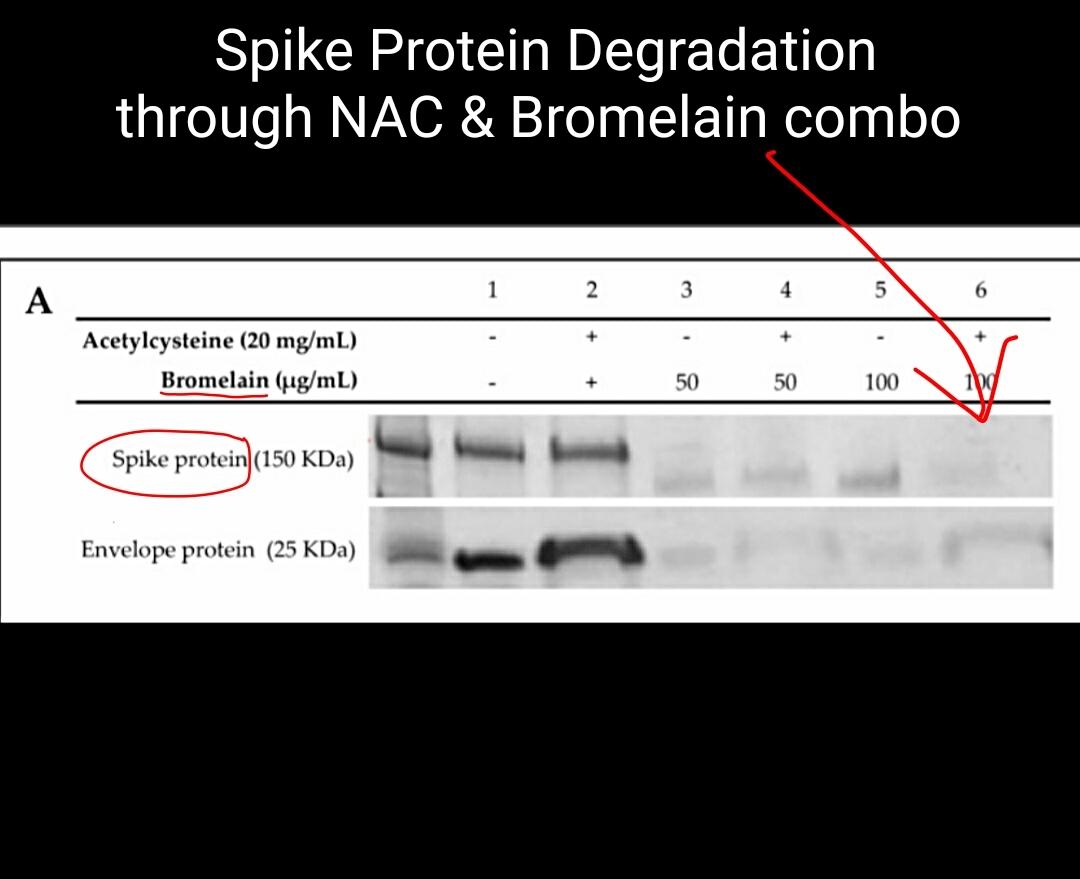
Below, is the study which showed two over-the-counter food supplements, Bromelain and Acetylcysteine (NAC), when used together – not separately – cause the spike protein bindings to fall apart and dissolve into nothing. Images of the results are below!
The Combination of Bromelain and Acetylcysteine (BromAc) Synergistically Inactivates SARS-CoV-2 by
1 Department of Surgery, St. George Hospital, Sydney, NSW 2217, Australia 2 Mucpharm Pty Ltd., Sydney, NSW 2217, Australia 3 CIRI, Centre International de Recherche en Infectiologie, Team VirPatH, Univ Lyon, Inserm, U1111, Université Claude Bernard Lyon 1, CNRS, UMR5308, ENS de Lyon, F-69007 Lyon, France 4 Hospices Civils de Lyon, EMR 3738 (CICLY), Lyon 1 Université, F-69921 Lyon, France 5 St. George & Sutherland Clinical School, University of New South Wales, Sydney, NSW 2217, Australia 6 Laboratoire de Virologie, Institut des Agents Infectieux (IAI), Hospices Civils de Lyon, Groupement Hospitalier Nord, F-69004 Lyon, France * Author to whom correspondence should be addressed. † These authors contributed equally to this work. ‡ These authors contributed equally to this work. Viruses 2021, 13(3), 425; https://doi.org/10.3390/v13030425 Received: 31 January 2021 / Revised: 25 February 2021 / Accepted: 1 March 2021 / Published: 6 March 2021 (This article belongs to the Special Issue Vaccines and Therapeutics against Coronaviruses)
Introduction The recently emergent severe acute respiratory syndrome coronavirus 2 (SARS-CoV-2) is the causative agent of coronavirus disease 2019 (COVID-19), which can range from asymptomatic to severe and lethal forms with a systemic inflammatory response syndrome. As of 21 February 2021, over 111 million confirmed cases have been reported, with an estimated overall mortality of 2.2% [1]. There are currently few therapeutic agents proven to be beneficial in reducing early- and late-stage disease progression [2]. While there are fortunately many vaccine candidates, their widespread availability for vaccination may not be immediate, the length of immune protection may be limited [3,4], and the efficacy of the vaccines may be reduced by novel SARS-CoV-2 variants. The continued exploration of effective treatments is therefore still needed.
Structurally, SARS-CoV-2 contains surface spike proteins, membrane proteins, and envelope proteins, as well as internal nucleoproteins that package the RNA. The spike protein is a homotrimer glycoprotein complex with different roles accomplished through dynamic conformational modifications, based in part on disulfide bonds [5]. It allows the infection of target cells by binding to the human angiotensin-converting enzyme (ACE2) receptors, among others, which triggers proteolysis by transmembrane protease serine 2 (TMPRSS2), furin, and perhaps other proteases, leading to virion and host cell membrane fusion [6,7].
The entry of viruses into mammalian cells, or “virus internalization”, is a key mechanism of enveloped virus infection and is based on dynamic conformational changes of their surface glycoproteins, namely, as mediated by disulfide bond reduction and regulated by cell surface oxydoreductases and proteases [5,8,9,10,11]. SARS-CoV-2 entry into host cells has been shown to start with destabilization of the spike protein through allosteric mechanical transition, which induces a conformational change from the closed “down” state to open “up” state of the receptor binding domain (RBD) of the spike protein [12,13]. The conformational changes of RBD and virus binding are induced by TMPRSS2 or Cathepsin L, which trigger the transition from the pre-fusion to post-fusion state [5,12,13]. The energy liberated by disulfide bond reduction increases protein flexibility, which is maximal when the reduced state is complete [8], thus allowing the fusion of host–virus membranes, which is otherwise impossible due to the repulsive hydration forces present before reduction [5].
Bromelain is extracted mainly from the stem of the pineapple plant (Ananas comosus) and contains a number of enzymes that give it the ability to hydrolyze glycosidic bonds in complex carbohydrates [14]. Previous studies have indicated that Bromelain removes the spike and hemagglutinin proteins of Semliki Forest virus, Sindbis virus, mouse gastrointestinal coronavirus, hemagglutinating encephalomyelitis virus, and H1N1 influenza viruses [15,16]. As a therapeutic molecule, it is used for debriding burns. Acetylcysteine is a powerful antioxidant that is commonly nebulized into the airways for mucus accumulation and is also used as a hepatoprotective agent in paracetamol overdose. Most importantly in the present context, Acetylcysteine reduces disulfide bonds [17]. Moreover, the association of the spike and envelope proteins by their respective triple cysteine motifs warrants the hypothesis of impacting virion stability following disulfide bridge disruption by the action of Acetylcysteine [18]. The combination of Bromelain and Acetylcysteine (BromAc) exhibits a synergistic mucolytic effect that is used in the treatment of mucinous tumors [19,20] and as a chemosensitizer of several anticancer drugs [21]. These different actions are due to the ability of BromAc to unfold the molecular structures of complex glycoproteins, thus allowing binding to occur because of the high affinity between RBD and ACE2.
Therefore, in the current study we set out to determine whether BromAc can disrupt the integrity of SARS-CoV-2 spike and envelope proteins and subsequently examine its inactivation potential against in vitro replication of two viral strains, including one with a spike mutant alteration of the novel S1/S2 cleavage site.
Materials and Methods 2.1. Materials
Bromelain API was manufactured by Mucpharm Pty Ltd (Kogarah, Australia) as a sterile powder. Acetylcysteine was purchased from Link Pharma (Cat# AUST R 170803; Warriewood, Australia). The recombinant SARS-COV-2 spike protein was obtained from SinoBiological (Cat# 40589-V08B1; Beijing, China). The recombinant envelope protein was obtained from MyBioSource (Cat# MBS8309649; San Diego, CA, USA). All other reagents were from Sigma Aldrich (St. Louis, MO, USA).
2.2. Recombinant Spike and Envelope Gel Electrophoresis
The spike or envelope proteins were reconstituted in sterile distilled water according to the manufacturer’s instructions, and aliquots were frozen at −20 °C. Two and a half micrograms of spike or envelope protein were incubated with 50 or 100 µg/mL Bromelain, 20 mg/mL Acetylcysteine, or a combination of both in Milli-Q water. The control contained no drugs. The total reaction volume was 15 µL each. After 30 min incubation at 37 °C, 5 µL of sample buffer was added into each reaction. A total of 20 µL of each reaction was electrophoresed on an SDS-PAGE (Cat# 456-1095; Bio-Rad Hercules, CA, USA). The gels were stained using Coomassie blue.
2.3. UV Spectral Detection of Disulfide Bonds in Spike and Envelope Proteins
The method of Iyer and Klee for the measurement of the rate of reduction of disulfide bonds has been used to detect disulfide bonds in spike and envelope proteins [22]. The recombinant SARS-CoV-2 spike protein at a concentration of 3.0 µg/mL in phosphate-buffered saline (PBS) (pH 7.0) containing 1 mM ethylenediaminetetraacetic acid (EDTA) was incubated with 0, 10, 20, 40, and 50 µL of Acetylcysteine (0.5 M), agitated at 37 °C for 30 min followed by equivalent addition of Dithiothreitol (DTT) (0.5 M), and agitated for a further 30 min at 37 °C. The spike protein was incubated in parallel only with DTT (0.5 M) as before without any Acetylcysteine and agitated at 37 °C for 30 min. The absorbance was then read at 310 nm. UV spectral detection of disulfide bonds in the envelope protein was performed in a similar manner.
2.4. SARS-CoV-2 Whole Virus Inactivation with BromAc
Fully respecting the World Health Organization (WHO) interim biosafety guidance related to the coronavirus disease, the SARS-CoV-2 whole virus inactivation tests were carried out with a wild-type (WT) strain representative of early circulating European viruses (GISAID accession number EPI_ISL_578176). A second SARS-CoV-2 strain (denoted as ∆S), reported through routine genomic surveillance in the Auvergne-Rhône-Alpes region of France, was added to the inactivation tests due to a rare mutation in the spike S1/S2 cleavage site and its culture availability in the laboratory (GISAID accession number EPI_ISL_578177).
2.5. Replication Kinetics by Real-Time Cell Analysis
To compare the in vitro replication capacity of both WT and ∆S SARS-CoV-2 strains, replication kinetics were determined by measuring the electrode impedance of microelectronic cell sensors on the xCELLigence Real-Time Cell Analyzer (RTCA) DP Instrument (ACEA Biosciences, Inc., San Diego, CA, USA). Vero cells were seeded at 20,000 cells per well on an E-Plate 16 (ACEA Biosciences, Inc., San Diego, CA, USA) and incubated with the same media conditions as described previously at 36 °C with 5% CO2. After 24 h, SARS-CoV-2 culture isolates were inoculated in triplicate at a multiplicity of infection of 10−2. Mock infections were performed in quadruplicate. Electronic impedance data (cell index) were continuously collected at 15-min intervals for 6 days. Area under the curve analysis of normalized cell index, established at time of inoculation, was then calculated at 12-h intervals. At each interval, cell viability was determined by normalizing against the corresponding cell control. Tukey multiple comparison tests were used to compare each condition on GraphPad Prism (software version 9.0; San Diego, CA, USA).
Results 3.1. Alteration of SARS-CoV-2 Spike and Envelope Proteins
Treatment of the spike protein with Acetylcysteine alone did not show any alteration of the protein, whereas concentrations of Bromelain at 50 and 100 µg/mL and BromAc at 50 and 100 µg/20 mg/mL resulted in protein alteration (Figure 1A). Treatment with Acetylcysteine on the envelope protein did not alter the protein, whereas treatment with Bromelain at 50 and 100 µg/mL and BromAc at 50 and 100 µg/20 mg/mL also resulted in near complete and complete fragmentation, respectively (Figure 1A).
Figure 1. (A) Bromelain and Acetylcysteine present a synergistic effect on severe acute respiratory syndrome coronavirus (SARS-CoV-2) spike and envelope protein destabilization. SDS-PAGE of the recombinant SARS-CoV-2 spike protein S1 + S2 subunits (150 kDa) and envelope protein (25 kDa). Proteins were treated with 20 mg/mL Acetylcysteine alone, 100 and 50 µg/mL Bromelain alone, and a combination of 100 and 50 µg/20 mg/mL BromAc. (B) Disulfide reduction of recombinant SARS-CoV-2 spike protein by Acetylcysteine. The differential assay between Acetylcysteine (Ac) and Dithiothreitol (DTT) for the reduction of disulfide bonds found on the spike protein indicates that Acetylcysteine reduces 42% of the disulfide bonds before the addition of DTT. The remaining bonds are reduced by DTT to produce the chromogen detected at 310 nm. (C) Disulfide reduction of recombinant SARS-CoV-2 envelope protein by Acetylcysteine. The differential assay between Acetylcysteine (Ac) and Dithiothreitol (DTT) for the reduction of disulfide bonds found on the envelope protein indicates that Acetylcysteine reduces 40% of the bonds before the addition of DTT.
3.2. UV Spectral Detection Demonstrates the Alteration of Disulfide Bonds in Spike and Envelope Proteins
The comparative reduction of disulfide bonds on the spike protein between DTT alone and DTT with Acetylcysteine demonstrated a 42% difference (Figure 1B), based on the slope of the graphs [0.002599/0.006171 (100) = 42 %]. Acetylcysteine was thus able to reduce 58% of the disulfide linkages in the sample, after which the remaining disulfide bonds were reduced by DTT to produce the chromogen that was monitored in the spectra. Similarly, the differential assay between Acetylcysteine and DTT for the reduction of disulfide bonds found in the envelope protein [0.007866/0.01293 (100) = 60%] indicates that Acetylcysteine reduces 40% of the disulfide bonds before the addition of DTT (Figure 1C).
3.3. In Vitro SARS-CoV-2 Inactivating Potential of Bromelain, Acetylcysteine, and BromAc
For both SARS-CoV-2 strains tested, the untreated virus controls at 105.5 and 104.5 TCID50/mL yielded typical cytopathic effects (CPE), and no cytotoxicity was observed for any of the drug combinations on Vero cells. Optical CPE results were invariably confirmed by end-point Neutral Red cell staining. Overall, Bromelain and Acetylcysteine treatment alone showed no viral inhibition, all with CPE comparable to virus control wells, whereas BromAc combinations displayed virus inactivation in a concentration-dependent manner (Figure 2). Treatment on 104.5 TCID50/mL virus titers (Figure 2B,D) yielded more consistent inhibition of CPE for quadruplicates than on 105.5 TCID50/mL virus titers (Figure 2A,C).
Figure 2. Cell lysis assays demonstrated in vitro inactivation potential of Acetylcysteine and Bromelain combined (BromAc) against SARS-CoV-2. Cell viability was measured by cell staining with Neutral Red, where optical density (OD) is directly proportional to viable cells. Low OD would signify important cell lysis due to virus replication. The wild-type (WT) SARS-CoV-2 strain at 5.5 and 4.5 log10TCID50/mL titers (A and B, respectively) showed no inhibition of cytopathic effect (CPE) for single agent treatment, compared to the mock treatment virus control condition. BromAc combinations were able to inhibit CPE, compared to the mock infection cell controls. Treatment of a SARS-CoV-2 spike protein variant (∆S) with a mutation at the S1/S2 junction at 5.5 and 4.5 log10TCID50/mL titers (C and D, respectively) showed similar results. Bars represent the average of each quadruplicate per condition, illustrated by white circles. Ordinary one-way ANOVA was performed, using the mock treatment virus control as the control condition (**** p < 0.0001, *** p < 0.0005, ** p < 0.003, and * p < 0.05).
Based on the virus inactivation guidelines established by the WHO, a robust and reliable process of inactivation will be able to reduce replication by at least 4 logs [Log10 reduction value (LRV) = (RT-PCR Ct treatment – RT-PCR Ct control)/3.3; as 1 log10 ≈ 3.3 Ct]. As such, RT-PCR was performed on the RNA extracts to directly measure virus replication. For the wild-type (WT) strain at 104.5 TCID50/mL, successful LRV > 4 were observed with 1 out of 4 wells, 2 out of 4 wells, 3 out of 4 wells, and 4 out of 4 wells for 25, 50, 100 and 250 µg/20 mg/mL BromAc, respectively (Figure 3). It is worth noting that at 105.5 TCID50/mL, LRV were slightly below the threshold at, on average, 3.3, with 3 out of 4 wells and 2 out of 4 wells for 100 and 250 µg/20 mg/mL BromAc, respectively (Table 1). For the spike protein mutant (∆S) at 104.5 TCID50/mL, no successful LRV > 4 was observed for 25 µg/20 mg/mL BromAc, but it was observed in 4 out of 4 wells for 50, 100, and 250 µg/20 mg/mL BromAc (Figure 3). Of note, at 105.5 TCID50/mL, LRV were slightly below the threshold at, on average, 3.2, with 1 out of 4 wells, 2 out of 4 wells, and 4 out of 4 wells for 50, 100, and 250 µg/20 mg/mL BromAc, respectively (Table 1). Overall, in vitro inactivation of both SARS-CoV-2 strains’ replication capacity was observed in a dose-dependent manner, most strongly demonstrated at 100 and 250 µg/20 mg/mL BromAc against 104.5 TCID50/mL of virus.
Figure 3. Threshold matrix of log10 reduction values (LRV) of in vitro virus replication 96 h after BromAc treatment on WT and ∆S SARS-CoV-2 strains at 5.5 and 4.5 log10TCID50/mL titers. LRV were calculated with the following formula: LRV = (RT-PCR Ct of treatment—RT-PCR Ct virus control)/3.3; as 1 log10 ≈ 3.3 Ct. The color gradient matrix displays the number of quadruplicates per condition yielding an LRV > 4, corresponding to a robust inactivation according to the WHO. WT = wild-type; ∆S = S1/S2 spike mutant.
Table 1. Log10 reduction values (LRV) of in vitro virus replication 96 h after BromAc treatment on WT and ∆S SARS-CoV-2 strains at 5.5 and 4.5 log10TCID50/mL titers. LRV were calculated with the following formula: LRV = (RT-PCR Ct of treatment – RT-PCR Ct virus control)/3.3; as 1 log10 ≈ 3.3 Ct. Each replicate is described. TCID50/mL = Median Tissue Culture Infectious Dose; WT = wild-type; ∆S = S1/S2 spike mutant.
Real-time cell analysis demonstrated comparable replication kinetics for both WT and ∆S SARS-CoV-2 strains (Figure 4). No significant difference in cell viability was observed between WT and ∆S at any time point. From 48 h post-infection, WT and ∆S cell viability were significantly different compared to the mock infection (p < 0.05).
Figure 4. SARS-CoV-2 replication capacity of WT and ∆S SARS-CoV-2 measured by Real-Time Cell Analysis. Data points correspond to area under the curve analysis of normalized cell index (electronic impedance of RTCA established at time of inoculation) at 12-h intervals. Cell viability was then determined by normalizing against the corresponding cell control. WT = wild-type; ∆S = S1/S2 spike mutant.
Discussion The combination of Bromelain and Acetylcysteine, BromAc, synergistically inhibited the infectivity of two SARS-CoV-2 strains cultured on Vero cells. Protein confirmation and its molecular properties are dependent on its structural and geometric integrity, which are dependent on both the peptide linkages and disulfide bridges. Acetylcysteine, as a good reducing agent, tends to reduce the disulfide bridges and hence alter the molecular properties of most proteins. This property has been widely exploited in the development of several therapies (chronic obstructive pulmonary disease, allergic airways diseases, cystic fibrosis, pseudomyxoma peritonei, etc.) [20,23,24,25,26,27]. More recently, Acetylcysteine has been used in the development of therapies for respiratory infections such as influenza and COVID-19 [28,29,30], where the integrity of the spike protein is vital for infection [12,13]. A hypothesized mechanism of action could be the unfolding of the spike glycoprotein and the reduction of its disulfide bonds.
The SARS-CoV-2 spike protein is the cornerstone of virion binding to host cells and hence represents an ideal therapeutic target. A direct mechanical action against this spike protein is a different treatment strategy in comparison to most of the existing antiviral drugs, which prevents viral entry in host cells rather than targeting the replication machinery. BromAc acts as a biochemical agent to destroy complex glycoproteins. Bromelain’s multipotent enzymatic competencies, dominated by the ability to disrupt glycosidic linkages, usefully complement Acetylcysteine’s strong power to reduce disulfide bonds [17]. Amino acid sequence analysis of the SARS-CoV-2 spike glycoprotein identified several predetermined sites where BromAc could preferentially act, such as the S2’ site rich in disulfide bonds [31], together with three other disulfide bonds in RBD [32]. In parallel, the role of the glycosidic shield in covering the spike, which is prone to being removed by BromAc, has been highlighted as a stabilization element of RBD conformation transitions as well as a resistance mechanism to specific immune response [5,33,34].
Mammalian cells exhibit reductive functions at their surface that are capable of cleaving disulfide bonds, and the regulation of this thiol-disulfide balance has been proven to impact the internalization of different types of viruses, including SARS-CoV-2 [8,35,36,37,38]. Both ACE2 and spike proteins possess disulfide bonds. When all the spike protein RBD disulfide bonds were reduced to thiols, ACE2 receptor binding to spike protein became less favorable [8]. Interestingly, the reduction of ACE2 disulfide bonds also induced a decrease in binding [8]. Moreover, other reports suggested that Bromelain alone could inhibit SARS-CoV-2 infection in VeroE6 cells through an action on disulfide links [39,40]. As such, the loss of SARS-CoV-2 infectivity observed after pre-treatment with BromAc could be correlated to the cumulative unfolding of the spike and envelope proteins, with a significant reduction of their disulfide bonds by Acetylcysteine, demonstrated in vitro.
Interestingly, a similar effect of BromAc was observed against both WT and ∆S SARS-CoV-2. The main difference in amino acid sequences between SARS-CoV-2 and previous SARS-CoV is the inclusion of a furin cleavage site between S1 and S2 domains [41]. This distinct site of the spike protein and its role in host spill-over and virus fitness is a topic of much debate [41,42,43,44]. Of note, ∆S, which harbors a mutation in this novel S1/S2 cleavage site and alters the cleavage motif, exhibits no apparent difference in replication capacity compared to the WT strain. The slightly increased sensitivity of ∆S to BromAc treatment is therefore not due to a basal replication bias, but the mutation could perhaps be involved in enhancing the mechanism of action of BromAc. These results would nevertheless suggest that, from a threshold dose, BromAc could potentially be effective on spike mutant strains. This may be a clear advantage for BromAc over specific immunologic mechanisms of a spike-specific vaccination [3,4].
To date, different treatment strategies have been tested, but no molecules have demonstrated a clear antiviral effect. In addition, given the heterogeneous disease outcome of COVID-19 patients, the treatment strategy should combine several mechanisms of action and be adapted to the stage of the disease. Thus, treatment repurposing remains an ideal strategy against COVID-19, whilst waiting for sufficient vaccination coverage worldwide [45,46]. In particular, the development of early nasal-directed treatment prone to decreasing a patient’s infectivity and preventing the progression towards severe pulmonary forms is supported by a strong rationale. Hou et al. demonstrated that the first site of infection is the nasopharyngeal mucosa, with secondary movement to the lungs by aspiration [47]. Indeed, the pattern of infectivity of respiratory tract cells followed ACE2 receptor expression, decreasing from the upper respiratory tract to the alveolar tissue. The ratio for ACE2 was five-fold greater in the nose than in the distal respiratory tract [40]. Other repurposing treatments as a nasal antiseptic have been tested in vitro, such as Povidone-Iodine, which has shown activity against SARS-CoV-2 [48]. In the present study, we showed the in vitro therapeutic potential of BromAc against SARS-CoV-2 with a threshold efficient dose at 100 µg/20 mg/mL. As animal airway safety models in two species to date have exhibited no toxicity (unpublished data), the aim is to test nasal administration of the drug in a phase I clinical trial (ACTRN12620000788976). Such treatment could help mitigate mild infections and prevent infection of persons regularly in contact with the virus, such as health-care workers.
Although our results are encouraging, there are a number of points to consider regarding this demonstration. Namely, the in vitro conditions are fixed and could be different from in vivo. Any enzymatic reaction is influenced by the pH of the environment, and even more so when it concerns redox reactions such as disulfide bond reduction [9]. The nasal mucosal pH is, in physiological terms, between 5.5 and 6.5 and increases in rhinitis to 7.2–8.3 [49]. Advanced age, often encountered in SARS-CoV-2 symptomatic infections, also induces a nasal mucosa pH increase [49]. Such a range of variation, depending on modifications typically induced by a viral infection, may challenge the efficacy of our treatment strategy. Further in vitro experiments to test various conditions of pH are ongoing, but ultimately, only clinical studies will be able to assess this point. Our experiments were led on a monkey kidney cell line known to be highly permissive to SARS-CoV-2 infectivity. With the above hypothesis of S protein lysis thiol-disulfide balance disruption, BromAc efficacy on SARS-CoV-2 should not be influenced by the membrane protease pattern. Reproducing this experimental protocol with the human pulmonary epithelial Calu-3 cell line (ATCC® HTB-55™) would allow these points to be addressed, as virus entry is TMPRSS2-dependent and pH-independent, as in airway epithelium, while virus entry in Vero cells is Cathepsin L-dependent, and thus pH-dependent [50].
Overall, results obtained from the present study in conjunction with complementary studies on BromAc properties and SARS-CoV-2 characterization reveal a strong indication that BromAc can be developed into an effective therapeutic agent against SARS-CoV-2.
Conclusions There is currently no suitable therapeutic treatment for early SARS-CoV-2 aimed at preventing disease progression. BromAc is under clinical development by the authors for mucinous cancers due to its ability to alter complex glycoprotein structures. The potential of BromAc on SARS-CoV-2 spike and envelope proteins stabilized by disulfide bonds was examined and found to induce the unfolding of recombinant spike and envelope proteins by reducing disulfide stabilizer bridges. BromAc also showed an inhibitory effect on wild-type and spike mutant SARS-CoV-2 by inactivation of its replication capacity in vitro. Hence, BromAc may be an effective therapeutic agent for early SARS-CoV-2 infection, despite mutations, and even have potential as a prophylactic in people at high risk of infection.
Author Contributions
Conceptualization, J.A., K.P., S.J.V., and D.L.M.; methodology, J.A., G.Q., K.P., S.B., and A.H.M.; validation, J.A., G.Q., K.P., V.K., S.B., and A.H.M.; investigation, J.A., G.Q., K.P., V.K., S.B., and A.H.M.; writing—original draft preparation, G.Q., K.P., V.K, A.H.M., E.F., and S.J.V.; supervision, D.L.M. and E.F.; project administration, S.J.V.; funding acquisition, S.J.V. and D.L.M. All authors have read and agreed to the published version of the manuscript.
Funding
This research is partly funded by Mucpharm Pty Ltd., Australia.
Data Availability Statement
A preprint of this manuscript was archived on http://www.biorxiv.org (accessed on 31 January 2021) due to the emergency of COVID-19.
Conflicts of Interest
David L. Morris is the co-inventor and assignee of the Licence for this study and director of the spin-off sponsor company, Mucpharm Pty Ltd. Javed Akhter, Krishna Pillai, and Ahmed Mekkawy are employees of Mucpharm Pty Ltd. Sarah Valle is partly employed by Mucpharm for its cancer development and is supported by an Australian Government Research Training Program Scholarship. Vahan Kepenekian thanks the Foundation Nuovo Soldati for its fellowship and was partly sponsored for stipend by Mucpharm Pty Ltd.
References
1 John’s Hopkins University Coronavirus Resource Centre. COVID-19 Dashboard by the Center for Systems Science and Engineering (CSSE) at Johns Hopkins University (JHU). Available online: https://coronavirus.jhu.edu/map.html(accessed on 7 February 2021).
2 Song, Y.; Zhang, M.; Yin, L.; Wang, K.; Zhou, Y.; Zhou, M.; Lu, Y. COVID-19 treatment: Close to a cure?–a rapid review of pharmacotherapies for the novel coronavirus. J. Antimicrob. Agents2020, 56, 106080. [Google Scholar] [CrossRef] [PubMed]
3 Zhu, F.C.; Guan, X.H.; Li, Y.H.; Huang, J.Y.; Jiang, T.; Hou, L.H.; Li, J.X.; Yang, B.F.; Wang, L.; Wang, W.J.; et al. Immunogenicity and safety of a recombinant adenovirus type-5-vectored COVID-19 vaccine in healthy adults aged 18 years or older: A randomised, double-blind, placebo-controlled, phase 2 trial. Lancet2020, 396, 479–488. [Google Scholar] [CrossRef]
4 Folegatti, P.M.; Ewer, K.J.; Aley, P.K.; Angus, B.; Becker, S.; Belij-Rammerstorfer, S.; Bellamy, D.; Bibi, S.; Bittaye, M.; Clutterbuck, E.A.; et al. Safety and immunogenicity of the ChAdOx1 nCoV-19 vaccine against SARS-CoV-2: A preliminary report of a phase 1/2, single-blind, randomised controlled trial. Lancet2020, 396, 467–478. [Google Scholar] [CrossRef]
6 Coutard, B.; Valle, C.; de Lamballerie, X.; Canard, B.; Seidah, N.G.; Decroly, E. The spike glycoprotein of the new coronavirus 2019-nCoV contains a furin-like cleavage site absent in CoV of the same clade. Antiviral Res.2020, 176, 104742. [Google Scholar] [CrossRef]
7 Vankadari, N.; Wilce, J.A. Emerging WuHan (COVID-19) coronavirus: Glycan shield and structure prediction of spike glycoprotein and its interaction with human CD26. Microbes Infect.2020, 9, 601–604. [Google Scholar] [CrossRef]
8 Hati, S.; Bhattacharyya, S. Impact of Thiol-Disulfide Balance on the Binding of Covid-19 Spike Protein with Angiotensin-Converting Enzyme 2 Receptor. ACS Omega2020, 5, 16292–16298. [Google Scholar] [CrossRef] [PubMed]
9 Lavillette, D.; Barbouche, R.; Yao, Y.; Boson, B.; Cosset, F.L.; Jones, I.M.; Fenouillet, E. Significant redox insensitivity of the functions of the SARS-CoV spike glycoprotein: Comparison with HIV envelope. Biol. Chem.2006, 281, 9200–9204. [Google Scholar] [CrossRef][Green Version]
10 Mathys, L.; Balzarini, J. The role of cellular oxidoreductases in viral entry and virus infection-associated oxidative stress: Potential therapeutic applications. Opin. Ther. Targets2016, 20, 123–143. [Google Scholar] [CrossRef][Green Version]
11 Wrapp, D.; Wang, N.; Corbett, K.S.; Goldsmith, J.A.; Hsieh, C.-L.; Abiona, O.; Graham, B.S.; McLellan, J.S. Cryo-EM structure of the 2019-nCoV spike in the prefusion conformation. Science2020, 367, 1260–1263. [Google Scholar] [CrossRef][Green Version]
12 Moreira, R.A.; Guzman, H.V.; Boopathi, S.; Baker, J.L.; Poma, A.B. Quantitative determination of mechanical stability in the novel coronavirus spike protein. Nanoscale2020, 12, 16409–16413. [Google Scholar] [CrossRef]
13 Moreira, R.A.; Guzman, H.V.; Boopathi, S.; Baker, J.L.; Poma, A.B. Characterization of Structural and Energetic Differences between Conformations of the SARS-CoV-2 Spike Protein. Materials2020, 13, 5362. [Google Scholar] [CrossRef] [PubMed]
14 Amini, A.; Masoumi-Moghaddam, S.; Morris, D.L. Utility of Bromelain and N-Acetylcysteine in Treatment of Peritoneal Dissemination of Gastrointestinal Mucin-Producing Malignancies; Springer: New York, NY, USA, 2016. [Google Scholar]
15 Schlegel, A.; Schaller, J.; Jentsch, P.; Kempf, C. Semliki Forest virus core protein fragmentation: Its possible role in nucleocapsid disassembly. Rep.1993, 13, 333–347. [Google Scholar] [CrossRef]
16 Greig, A.S.; Bouillant, A.M. Binding effects of concanavalin A on a coronavirus. J. Comp. Med.1977, 41, 122–126. [Google Scholar]
17 Pillai, K.; Akhter, J.; Chua, T.C.; Morris, D.L. A formulation for in situ lysis of mucin secreted in pseudomyxoma peritonei. J. Cancer2014, 134, 478–486. [Google Scholar] [CrossRef]
19 Pillai, K.; Akhter, J.; Morris, D.L. Assessment of a novel mucolytic solution for dissolving mucus in pseudomyxoma peritonei: An ex vivo and in vitro study. Pleura Peritoneum2017, 2, 111–117. [Google Scholar] [CrossRef] [PubMed]
20 Valle, S.J.; Akhter, J.; Mekkawy, A.H.; Lodh, S.; Pillai, K.; Badar, S.; Glenn, D.; Power, M.; Liauw, W.; Morris, D.L. A novel treatment of bromelain and acetylcysteine (BromAc) in patients with peritoneal mucinous tumours: A phase I first in man study. J. Surg. Oncol.2021, 47, 115–122. [Google Scholar] [CrossRef] [PubMed]
21 Pillai, K.; Mekkawy, A.H.; Akhter, J.; Badar, S.; Dong, L.; Liu, A.I.; Morris, D.L. Enhancing the potency of chemotherapeutic agents by combination with bromelain and N-acetylcysteine—An in vitro study with pancreatic and hepatic cancer cells. J. Transl. Res.2020, 12, 7404–7419. [Google Scholar]
22 Iyer, K.S.; Klee, W.A. Direct spectrophotometric measurement of the rate of reduction of disulfide bonds. The reactivity of the disulfide bonds of bovine -lactalbumin. Biol. Chem.1973, 248, 707–710. [Google Scholar]
23 Zhang, Q.; Ju, Y.; Ma, Y.; Wang, T. N-acetylcysteine improves oxidative stress and inflammatory response in patients with community acquired pneumonia: A randomized controlled trial. Medicine2018, 97, 45. [Google Scholar] [CrossRef] [PubMed]
25 Calzetta, L.; Rogliani, P.; Facciolo, F.; Rinaldi, B.; Cazzola, M.; Matera, M.G. N-Acetylcysteine protects human bronchi by modulating the release of neurokinin A in an ex vivo model of COPD exacerbation. Biomed Pharm.2018, 103, 1–8. [Google Scholar] [CrossRef]
26 Cazzola, M.; Calzetta, L.; Facciolo, F.; Rogliani, P.; Matera, M.G. Pharmacological investigation on the anti-oxidant and anti-inflammatory activity of N-acetylcysteine in an ex vivo model of COPD exacerbation. Res.2017, 18, 26. [Google Scholar] [CrossRef] [PubMed]
28 Suhail, S.; Zajac, J.; Fossum, C.; Lowater, H.; McCracken, C.; Severson, N.; Laatsch, B.; Narkiewicz-Jodko, A.; Johnson, B.; Liebau, J. Role of Oxidative Stress on SARS-CoV (SARS) and SARS-CoV-2 (COVID-19) Infection: A Review. Protein J.2020, 39, 1–13. [Google Scholar] [CrossRef]
29 De Flora, S.; Balansky, R.; La Maestra, S. Rationale for the use of N-acetylcysteine in both prevention and adjuvant therapy of COVID-19. FASEB J.2020, 34, 13185–13193. [Google Scholar] [CrossRef]
30 Guerrero, C.A.; Acosta, O. Inflammatory and oxidative stress in rotavirus infection. World J. Virol.2016, 5, 38. [Google Scholar] [CrossRef] [PubMed]
31 Walls, A.C.; Park, Y.J.; Tortorici, M.A.; Wall, A.; McGuire, A.T.; Veesler, D. Structure, Function, and Antigenicity of the SARS-CoV-2 Spike Glycoprotein. Cell2020, 181, 281–292. e6. [Google Scholar] [CrossRef]
32 Li, W.; Zhang, C.; Sui, J.; Kuhn, J.H.; Moore, M.J.; Luo, S.; Wong, S.K.; Huang, I.C.; Xu, K.; Vasilieva, N.; et al. Receptor and viral determinants of SARS-coronavirus adaptation to human ACE2. EMBO J.2005, 24, 1634–1643. [Google Scholar] [CrossRef] [PubMed][Green Version]
33 Watanabe, Y.; Allen, J.D.; Wrapp, D.; McLellan, J.S.; Crispin, M. Site-specific glycan analysis of the SARS-CoV-2 spike. Science2020, 369, 330–333. [Google Scholar] [CrossRef]
34 Casalino, L.; Gaieb, Z.; Goldsmith, J.A.; Hjorth, C.K.; Dommer, A.C.; Harbison, A.M.; Fogarty, C.A.; Barros, E.P.; Taylor, B.C.; McLellan, J.S. Beyond shielding: The roles of glycans in the SARS-CoV-2 spike protein. ACS Cent. Sci.2020, 6, 1722–1734. [Google Scholar] [CrossRef]
35 Ryser, H.; Levy, E.M.; Mandel, R.; DiSciullo, G.J. Inhibition of human immunodeficiency virus infection by agents that interfere with thiol-disulfide interchange upon virus-receptor interaction. Natl. Acad. Sci. USA1994, 91, 4559–4563. [Google Scholar] [CrossRef] [PubMed][Green Version]
36 Kennedy, S.I. The effect of enzymes on structural and biological properties of Semliki forest virus. Gen. Virol.1974, 23, 129–143. [Google Scholar] [CrossRef]
37 Schlegel, A.; Omar, A.; Jentsch, P.; Morell, A.; Kempf, C. Semliki Forest virus envelope proteins function as proton channels. Rep.1991, 11, 243–255. [Google Scholar] [CrossRef]
38 Compans, R.W. Location of the glycoprotein in the membrane of Sindbis virus. New Biol.1971, 229, 114–116. [Google Scholar] [CrossRef] [PubMed]
40 Korber, B.; Fischer, W.M.; Gnanakaran, S.; Yoon, H.; Theiler, J.; Abfalterer, W.; Hengartner, N.; Giorgi, E.E.; Bhattacharya, T.; Foley, B. Tracking changes in SARS-CoV-2 Spike: Evidence that D614G increases infectivity of the COVID-19 virus. Cell2020, 182, 812–827. [Google Scholar] [CrossRef] [PubMed]
41 Zhou, H.; Chen, X.; Hu, T.; Li, J.; Song, H.; Liu, Y.; Wang, P.; Liu, D.; Yang, J.; Holmes, E.C.; et al. A Novel Bat Coronavirus Closely Related to SARS-CoV-2 Contains Natural Insertions at the S1/S2 Cleavage Site of the Spike Protein. Biol.2020, 30, 2196–2203. [Google Scholar] [CrossRef] [PubMed]
42 Jaimes, J.A.; Millet, J.K.; Whittaker, G.R. Proteolytic Cleavage of the SARS-CoV-2 Spike Protein and the Role of the Novel S1/S2 Site. iScience2020, 23, 101212. [Google Scholar]
44 Hoffmann, M.; Kleine-Weber, H.; Pohlmann, S. A Multibasic Cleavage Site in the Spike Protein of SARS-CoV-2 Is Essential for Infection of Human Lung Cells. Cell2020, 78, 779–784. [Google Scholar] [CrossRef] [PubMed]
45 Walsh, E.E.; Frenck, R.W., Jr.; Falsey, A.R.; Kitchin, N.; Absalon, J.; Gurtman, A.; Lockhart, S.; Neuzil, K.; Mulligan, M.J.; Bailey, R.; et al. Safety and Immunogenicity of Two RNA-Based Covid-19 Vaccine Candidates. Engl. J. Med.2020, 383, 2439–2450. [Google Scholar] [CrossRef]
46 Andersen, P.I.; Ianevski, A.; Lysvand, H.; Vitkauskiene, A.; Oksenych, V.; Bjoras, M.; Telling, K.; Lutsar, I.; Dumpis, U.; Irie, Y.; et al. Discovery and development of safe-in-man broad-spectrum antiviral agents. J. Infect. Dis.2020, 93, 268–276. [Google Scholar] [CrossRef]
Akhter J, Quéromès G, Pillai K, Kepenekian V, Badar S, Mekkawy AH, Frobert E, Valle SJ, Morris DL. The Combination of Bromelain and Acetylcysteine (BromAc) Synergistically Inactivates SARS-CoV-2. Viruses. 2021; 13(3):425. https://doi.org/10.3390/v13030425
Chicago/Turabian Style
Akhter, Javed, Grégory Quéromès, Krishna Pillai, Vahan Kepenekian, Samina Badar, Ahmed H. Mekkawy, Emilie Frobert, Sarah J. Valle, and David L. Morris. 2021. “The Combination of Bromelain and Acetylcysteine (BromAc) Synergistically Inactivates SARS-CoV-2” Viruses 13, no. 3: 425. https://doi.org/10.3390/v13030425
Two Must-See Expert Interviews On The Covid-19 Vaccines
COMMENT (By a soul):
If you have limited time and are needing to convince loved ones not to take the Covid-19 mRNA vaccines, these two videos are by far the best for your loved ones to watch. The first video discusses the fact that they are abortion-tainted vaccines; and the second video discusses the fact that the vaccines genetically modify and reprogram the DNA in your body and the health dangers associated with genetic manipulation. God bless!
Video One – LifeSiteNews – The John-Henry Westen Show – The Origin of the Abortion-Tainted Vaccines Will Sicken You (1:01:00 minutes)
SUMMARY: In this January 12, 2021 episode of LifeSiteNews: The John-Henry Westen Show, Westen interviews Pamela Acker, one of the most knowledgeable people in the world on vaccines and on what goes into them.
KEY POINTS:
* The unborn babies used for vaccine development were alive at tissue extraction (within 5 minutes of the abortion; delivered alive for preservation of tissues)
* Usually more than 100 abortions are completed in order to generate one pure viable aborted baby fetal cell line for research
* On-going use of the vaccine means that there will be on-going use of the aborted baby fetal cell line for research, development, and testing
Video Two – Covid-19 mRNA Vaccines – January 24, 2021 Report #227 – Dr. Carrie Madej – Reprogramming of Cells Without Informed Consent – Moratorium Needed (1:08:54 minutes)
SUMMARY: Blockbuster conversation with Dr. Carrie Madej exposing the fact that the Pfizer and Moderna COVID-vaccine is experimental in nature, has not been properly tested in humans, has not been proven safe and effective- (she explains closely how the raw data has been manipulated), and raises many questions regarding dangerous side-effects and adverse events, including death, as well as pointing to the genetic reprogramming of human cells without informed consent provided to those who take it: this is a transhumanizing and nanobot-containing vaccine, but people do not seem to understand this; given the multiple numbers of adverse effects being reported, she calls for an immediate moratorium to halt the rollout and calls for medical professionals to speak out.
KEY POINTS:
* Video/Article has more explanation from Dr. Carrie Madej on what is in the vaccines and exactly how the nanoparticles work
* Many facts in the video/article support scientifically what the heavenly messages (prophets) are saying at this time about the vaccines using mRNA




 Mary Refuge Of Souls